Tuesday, 22 January 2013
Tuesday, 15 January 2013
First Computer Games

I will start reporting more on Australia forgotten computer science history. In this 1956 article the use of CIRAC to play games is mention. Geoffrey Hill is attributed as the creator of the first computer music in 1948 -52, and this article shows he was working early on computer games,
I will start reporting more on Australia forgotten computer science history. In this 1956 article the use of CIRAC to play games is mention. Geoffrey Hill is attributed as the creator of the first computer music in 1948 -52, and this article shows he was working early on computer games,


Saturday, 12 January 2013
Charlemagne
I have just read a very readable history of Charlemagne. It was by a 1970's Christian historian, so it was a popular easy read.

I was interest in this era, as learning was going backwards as politics got out of hand. Today it is heresy to say some aspects of education are lost in politics.
I found the following things interesting:
1) Dark ages society was an interwoven mix of Gallo Roman classical life, Barbarian (Goth) and first wave administrators, and layers of subsequent barbarians (the Franks)
2) Monastic architecture with cloisters were essentially derived from Roman villas, and the structure with monks and more worldly abbots, reflected Roman house holds with the Freemen and Slaves.
3) Kings in 600 quickly lost power to Nobles and Mayors as they pursued the Kings life and handed over the running of the country.
4) Pepin a mayor got Rome to reboot the king process by making him King of the Franks, this was enabled by the "cutting the hair" of the old king, and him being thrown aloft on his shield three times. This was a mix of Christianity and Heathen cultures.
5) The Saxons had a "Pillar of the world" around which they horded treasure
6) The Huns had treasure held in a Nine ring defence
7) Charlemagne killed 4500 Saxon men, and started a Saxon up rising.
9) The German practice of making all sons inherit a divided kingdom, kept things small and easy to administer. The practice of having more than one wife (Teutonic) and concubines (eastern) lead to an explosion of heirs.

I was interest in this era, as learning was going backwards as politics got out of hand. Today it is heresy to say some aspects of education are lost in politics.
I found the following things interesting:
1) Dark ages society was an interwoven mix of Gallo Roman classical life, Barbarian (Goth) and first wave administrators, and layers of subsequent barbarians (the Franks)
2) Monastic architecture with cloisters were essentially derived from Roman villas, and the structure with monks and more worldly abbots, reflected Roman house holds with the Freemen and Slaves.
3) Kings in 600 quickly lost power to Nobles and Mayors as they pursued the Kings life and handed over the running of the country.
4) Pepin a mayor got Rome to reboot the king process by making him King of the Franks, this was enabled by the "cutting the hair" of the old king, and him being thrown aloft on his shield three times. This was a mix of Christianity and Heathen cultures.
5) The Saxons had a "Pillar of the world" around which they horded treasure
6) The Huns had treasure held in a Nine ring defence
7) Charlemagne killed 4500 Saxon men, and started a Saxon up rising.
9) The German practice of making all sons inherit a divided kingdom, kept things small and easy to administer. The practice of having more than one wife (Teutonic) and concubines (eastern) lead to an explosion of heirs.
Friday, 23 March 2012
More on Black Bodies
What we strictly have to cover in the Syllabus
8.5.3.2.1 That is focus area 5 column 2 point 1
define the relationship between the
temperature of a body and the
dominant wavelength of the radiation
emitted from that body
On the most basic level a body is an object of more than a few hundred atoms, and the hotter it is the more blue it is.
Blackbodies are a class of bodies that were theoretically discussed in 1860 by a scientist call Kirchoff,
Simply put anylight falling on them get absorbed so that any light coming from them has been generated by the body. Now for the next 40 years scientist fooled around making blackbody radiators, then taking spectra. Finally they got black body spectra and Planck modeled it and this lead to Modern Physics, but that is another story

1900 was close enough to make do calculations. 2009 we are getting close but we are still not there, light goes in and never comes out, only the heat light comming from the body. So far "blackbody" only really turns up next year in the HSC Astrophysics Option.
So the modern defintion of a Blackbody radiator is
A blackbody allows all incident radiation to pass into it (no reflected energy) and internally absorbs all the incident radiation (no energy transmitted through the body). This is true of radiation for all wavelengths and for all angles of incidence. Hence the blackbody is a perfect absorber for all incident radiation
Siegel, Robert; Howell, John R. (2002). Thermal Radiation Heat Transfer; Volume 1 (4th ed.). Taylor & Francis. p. 7. ISBN 1-56032-839-8. http://books.google.com/books?id=O389yQ0-fecC&pg=PA7.
So here is my summary from the point of view of a spectroscophist, baring in mind
Most things coffee cups and stars, are good black body radiators in the visible, perfect in the infrared, and to varying degrees poor in the UV. So if you use the black body Weins law that looks at the peak wavelength, you get a good temperature, if you use an infrared bolometer that looks at the curve in the IR you get a great reading, and UV you get a more or less view of the structure of what you are looking at. That is how different it is from a little Pt box with carbon nano tubes in it.
 This is a plot of how badly stars deviate from the BBR curve (black) in the UV which people dont use to determine temperature, because the curve is not valid there. Basically the is not a fix surface for a surface temperture. Stars get hotter in the inside, and so there is no defined temperature. Supergiants have colder outer layers to the UV escape surface is higher. The curves above represent UV deficit
More in depth is given in this web text http://cseligman.com/text/sun/blackbody.htm
 This is from, http://homepages.wmich.edu/~korista/sun-images/solar_specbb.jpg as you can see
1. IR good
2. Peak fair
3. UV lousy
I would interpret this as the UV light powering, more visible light from the sun but this is an observation not a published piece of science.
8.5.3.2.1 That is focus area 5 column 2 point 1
define the relationship between the
temperature of a body and the
dominant wavelength of the radiation
emitted from that body
On the most basic level a body is an object of more than a few hundred atoms, and the hotter it is the more blue it is.
Blackbodies are a class of bodies that were theoretically discussed in 1860 by a scientist call Kirchoff,
Simply put anylight falling on them get absorbed so that any light coming from them has been generated by the body. Now for the next 40 years scientist fooled around making blackbody radiators, then taking spectra. Finally they got black body spectra and Planck modeled it and this lead to Modern Physics, but that is another story

1900 was close enough to make do calculations. 2009 we are getting close but we are still not there, light goes in and never comes out, only the heat light comming from the body. So far "blackbody" only really turns up next year in the HSC Astrophysics Option.
So the modern defintion of a Blackbody radiator is
A blackbody allows all incident radiation to pass into it (no reflected energy) and internally absorbs all the incident radiation (no energy transmitted through the body). This is true of radiation for all wavelengths and for all angles of incidence. Hence the blackbody is a perfect absorber for all incident radiation
Siegel, Robert; Howell, John R. (2002). Thermal Radiation Heat Transfer; Volume 1 (4th ed.). Taylor & Francis. p. 7. ISBN 1-56032-839-8. http://books.google.com/books?id=O389yQ0-fecC&pg=PA7.
So here is my summary from the point of view of a spectroscophist, baring in mind
Most things coffee cups and stars, are good black body radiators in the visible, perfect in the infrared, and to varying degrees poor in the UV. So if you use the black body Weins law that looks at the peak wavelength, you get a good temperature, if you use an infrared bolometer that looks at the curve in the IR you get a great reading, and UV you get a more or less view of the structure of what you are looking at. That is how different it is from a little Pt box with carbon nano tubes in it.
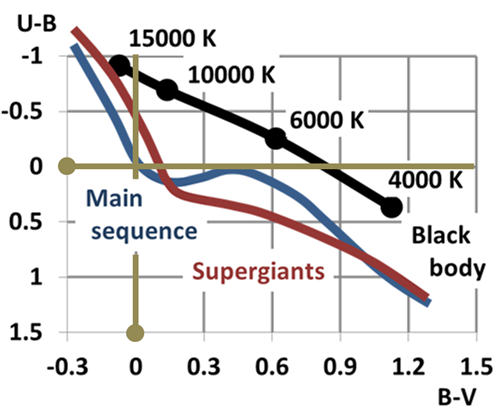
More in depth is given in this web text http://cseligman.com/text/sun/blackbody.htm

1. IR good
2. Peak fair
3. UV lousy
I would interpret this as the UV light powering, more visible light from the sun but this is an observation not a published piece of science.
Sunday, 12 February 2012

How to understand Electrons

2. Electrons(example e- and e- from the Mg++) swim around the nuclei
2.1 Here is a realistic picture of electrons swimming around a metal, They are not "classical electrons" but actually give bulk to the metal (dont worry until you do Quantum Mechanics at UNI)
3. Electrons are like trout in a tank, the walls are like the WORK FUNCTION
4. There are three ways to get electrons out of a metal
4.1 Fire an ion from a low pressure gas (throw a rock in the trout pond and trout will jump out)
4.2 Heat up the metal called THERMIONIC EMISSION (Heat it up Elmo?)
4.3 Hit out the electrons with UV light PHOTOELECTRIC effect (Laser)
Tuesday, 16 August 2011
Is there a relationship between metal lattice distances and resistivity?


What a great site Web Elements is !
The red ones are the d block standard metals.
Copper, silver gold are in a line copper silver gold
Iron is dark grey, mercury light grey.
The last period is has many null values
What do you think? Does a large r (top) lead to low resistivity (bottom)?
Sunday, 14 August 2011
Do magnetic field lines exert a pressure?
There is a model of magnetic field taught in New South Wales schools that predicts how two magnets or a magnet and wire will behave:
Step 1: For two devices draw independent field.
Step 2: Draw the resultant fields.
Step 3: The resultant diagram has area of high and low field density, the field lines are given the properties of gas molecules that exert some sort of packing pressure against items in the diagram.

So in the above diagram there are
(A) 6 lines outside 4 lines inside ....outside wins the wires attract.
(B) 6 lines outside 12 inside ..... to crowded inside repel.
Here is for a motor from Electrical Science Fundamentals Handbook
 This is a neat visualization guide, if the lines where springs they would push the conductor.
Comment 1: The maths F = BilSin(theta) considers the field only at the conductor.
Comment 2: The fields do not interact, but sum.
Comment 3: Faraday was completely non mathematical, and offered "lines of force" as a non scientific guide. Maxwell tried to develop this into "tubes of force" to attempt a mathematical explanation. This was abandoned some 150 years ago.
Comment 4: The discovery of the electron and special relativity means magnetic fields from currents are understood as an extension of electrostatics. Magnetic fields from permanent magnets are explained by Quantum Mechanics and special relativity. This presents a problem to a high school teacher as this is outside the breadth of school physics.
Comment 5: This path back to electrostatics still does not clear away for deep understanding. Force at a distance can be managed by the construct of fields, which is a mathematical device that overlays an answer field. The exchange of virtual particles radiating over distance is used by Quantum Field Theory and Feymann
diagrams. The curvature of space, created by mass or charge, then telling the other particle how to move has been developed by Einstein's General Relativity. The most up to date theory is 'bane' theory, string theory or M theory.
This a to look at
Step 1: For two devices draw independent field.
Step 2: Draw the resultant fields.
Step 3: The resultant diagram has area of high and low field density, the field lines are given the properties of gas molecules that exert some sort of packing pressure against items in the diagram.
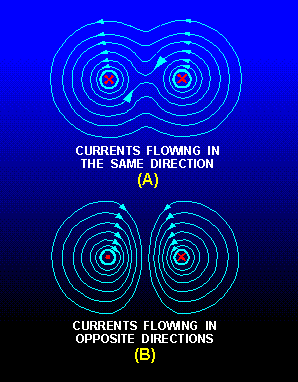
So in the above diagram there are
(A) 6 lines outside 4 lines inside ....outside wins the wires attract.
(B) 6 lines outside 12 inside ..... to crowded inside repel.
Here is for a motor from Electrical Science Fundamentals Handbook

Comment 1: The maths F = BilSin(theta) considers the field only at the conductor.
Comment 2: The fields do not interact, but sum.
Comment 3: Faraday was completely non mathematical, and offered "lines of force" as a non scientific guide. Maxwell tried to develop this into "tubes of force" to attempt a mathematical explanation. This was abandoned some 150 years ago.
Comment 4: The discovery of the electron and special relativity means magnetic fields from currents are understood as an extension of electrostatics. Magnetic fields from permanent magnets are explained by Quantum Mechanics and special relativity. This presents a problem to a high school teacher as this is outside the breadth of school physics.
Comment 5: This path back to electrostatics still does not clear away for deep understanding. Force at a distance can be managed by the construct of fields, which is a mathematical device that overlays an answer field. The exchange of virtual particles radiating over distance is used by Quantum Field Theory and Feymann
diagrams. The curvature of space, created by mass or charge, then telling the other particle how to move has been developed by Einstein's General Relativity. The most up to date theory is 'bane' theory, string theory or M theory.
This a to look at
Friday, 12 August 2011
Sunday, 7 August 2011
Space Physics Brain Teasers
Can you figure out the Rocket Science Equation that goes with this picture?


..... or this one ?

... or this one ?

Subscribe to:
Posts (Atom)