Tuesday, 16 August 2011
Is there a relationship between metal lattice distances and resistivity?
What a great site Web Elements is !
The red ones are the d block standard metals.
Copper, silver gold are in a line copper silver gold
Iron is dark grey, mercury light grey.
The last period is has many null values
What do you think? Does a large r (top) lead to low resistivity (bottom)?
Sunday, 14 August 2011
Do magnetic field lines exert a pressure?
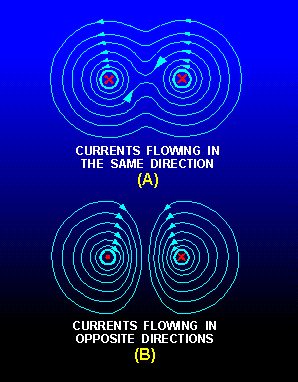
There is a model of magnetic field taught in New South Wales schools that predicts how two magnets or a magnet and wire will behave:
Step 1: For two devices draw independent field.
Step 2: Draw the resultant fields.
Step 3: The resultant diagram has area of high and low field density, the field lines are given the properties of gas molecules that exert some sort of packing pressure against items in the diagram.
So in the above diagram there are
(A) 6 lines outside 4 lines inside ....outside wins the wires attract.
(B) 6 lines outside 12 inside ..... to crowded inside repel.
Here is for a motor from Electrical Science Fundamentals Handbook
This is a neat visualization guide, if the lines where springs they would push the conductor.
Comment 1: The maths F = BilSin(theta) considers the field only at the conductor.
Comment 2: The fields do not interact, but sum.
Comment 3: Faraday was completely non mathematical, and offered "lines of force" as a non scientific guide. Maxwell tried to develop this into "tubes of force" to attempt a mathematical explanation. This was abandoned some 150 years ago.
Comment 4: The discovery of the electron and special relativity means magnetic fields from currents are understood as an extension of electrostatics. Magnetic fields from permanent magnets are explained by Quantum Mechanics and special relativity. This presents a problem to a high school teacher as this is outside the breadth of school physics.
Comment 5: This path back to electrostatics still does not clear away for deep understanding. Force at a distance can be managed by the construct of fields, which is a mathematical device that overlays an answer field. The exchange of virtual particles radiating over distance is used by Quantum Field Theory and Feymann
diagrams. The curvature of space, created by mass or charge, then telling the other particle how to move has been developed by Einstein's General Relativity. The most up to date theory is 'bane' theory, string theory or M theory.
This a to look at
Step 1: For two devices draw independent field.
Step 2: Draw the resultant fields.
Step 3: The resultant diagram has area of high and low field density, the field lines are given the properties of gas molecules that exert some sort of packing pressure against items in the diagram.
So in the above diagram there are
(A) 6 lines outside 4 lines inside ....outside wins the wires attract.
(B) 6 lines outside 12 inside ..... to crowded inside repel.
Here is for a motor from Electrical Science Fundamentals Handbook
This is a neat visualization guide, if the lines where springs they would push the conductor.
Comment 1: The maths F = BilSin(theta) considers the field only at the conductor.
Comment 2: The fields do not interact, but sum.
Comment 3: Faraday was completely non mathematical, and offered "lines of force" as a non scientific guide. Maxwell tried to develop this into "tubes of force" to attempt a mathematical explanation. This was abandoned some 150 years ago.
Comment 4: The discovery of the electron and special relativity means magnetic fields from currents are understood as an extension of electrostatics. Magnetic fields from permanent magnets are explained by Quantum Mechanics and special relativity. This presents a problem to a high school teacher as this is outside the breadth of school physics.
Comment 5: This path back to electrostatics still does not clear away for deep understanding. Force at a distance can be managed by the construct of fields, which is a mathematical device that overlays an answer field. The exchange of virtual particles radiating over distance is used by Quantum Field Theory and Feymann
diagrams. The curvature of space, created by mass or charge, then telling the other particle how to move has been developed by Einstein's General Relativity. The most up to date theory is 'bane' theory, string theory or M theory.
This a to look at
Friday, 12 August 2011
Sunday, 7 August 2011
Space Physics Brain Teasers
Can you figure out the Rocket Science Equation that goes with this picture?
..... or this one ?
... or this one ?
Sunday, 31 July 2011
Chemicals on the web - Cubane.
Computer simulated molecules are a great way to learn Chemistry. When I found out about Cubane C8H8 I thought it was time to review how to "Surf" the web and see new molecules.
There are a number of great web rendering of molecules:
1. JMOL
How? Search your molecule on Google + "JMOL"
Good things - any browser, any molecule
Bad - can bend bonds
2. CHIME
How? 1. Download Chime plugin, send in info to publisher
then search Chime + Molecule.
Good things: Can "Scupt" molecules and get a real feel for them
Bad things: you can only show your class on your data projector/ IWB
3. CanvasMOL
How? Just follow this link
Good things: Fast and molcule focused.
Cubane!
There are a number of great web rendering of molecules:
1. JMOL
How? Search your molecule on Google + "JMOL"
Good things - any browser, any molecule
Bad - can bend bonds
2. CHIME
How? 1. Download Chime plugin, send in info to publisher
then search Chime + Molecule.
Good things: Can "Scupt" molecules and get a real feel for them
Bad things: you can only show your class on your data projector/ IWB
3. CanvasMOL
How? Just follow this link
Good things: Fast and molcule focused.
Cubane!
Wednesday, 27 July 2011
Monday, 25 July 2011
Penrith High reaches + 9 g force in Lab.
Actually it was just swirling a marble in a mop bucket.
The bucket wall was 84 degrees. g x 1/cos(84) = 9.5 g.
Students were asked to calculate the mass required to cause this acceleration at 15 cm in the center of the bucket.
The difference between the bucket and gravitation is that the bucket applies a force at the point of contact of the marble and force pushes and stress through out the marble, where as a gravitational field would tug uniformly throughout the marble. Gravitation gently accelerates the whole marble.
If you were in the marble, in the bucket you would be crushed to death, were as in the gravitational field as the force is spread evenly through out your body you would feel "Weightless". This is also why comets are not crushed as they swing near the Sun.
I am always looking for this explanation in Textbook, as without it it is most confusing.
Wednesday, 20 July 2011
Eating Sunshine! -Lesson Transcript
Ecology - Transcript
Living things and life; an ecosystem is something that relies upon all of its workings units. Eco means home. An ecosystem is the mechanism of a home. Ology means 'love of'. An ecology is then, by definition the love of or study of mechanisms within an environment or home.
All living things have to eat. I worked out that all life ultimately eats sunlight, or light provided by the sun. Therefore, what is the very first thing you draw in any ecosystem? Answer: The Sun.
Arrows always come from the sun and follow to the grass and continues on the largest predator.
The first thing in an ecosystem is the sun. The first stage of an ecosystem is photosynthesis. This means eating light. Photosynthesis is basically the reason life works and how flora eats light, takes in carbon dioxide or CO2 and emits it back into the atmosphere.
Trees are formed when water and oxygen are 'knitted' together in straight out air.
Thursday, 7 July 2011
Technology on the move with a classroom Rover named "Violet".
Manufacturer | prototype built by Dr Hill |
Weight | 36 kg |
Power | mains |
Terrain Capability | unsealed surfaces / grass / 25 degree slopes |
Deployment time | 30 seconds average door to lesson start |
Integrated Hardware | 1) Data projector (3D) - adjustable mount |
| 2) Fujitsu Lifebook Tablet PC + docking station | |
| 3) Gyro - mouse for full classroom interaction | |
| 4) Bluetooth Key board | |
| 5) Mobile IP camera | |
| 6) High speed document dual head scanner | |
| 7) 140 W sound system | |
| 8) Technology draw | |
- USB microscope | |
- USB document camera | |
- light, temperature meters | |
- DSO nano | |
Safety: | Passive air cooling |
| Industrial Wiring/Earthing | |
| Ergonomic Design | |
Pedagogic Advantage | Technology is central in classroom, and moves to student by Keyboard and mouse. |
Technology goes from store to student more transparently, faster training | |
Price | $ 8,360 USD |
I have built work stations for laser labs, and high technology production lines. "Violet" is ahead of fixed infrastructure IWB on a number of factors. The value is in the bundled and integrated systems.
For more info contact peter.hill26@det.nsw.edu.au
Tuesday, 5 July 2011
Heads up on Rainbows
Rainbows are polarized - rotating a polarizing filter shows that the only light coming from a rainbow has an electric field oscillating at 90 deg to the rainbow.
Note the Mie scattering white under cloud "holding up the rainbow" is also removed.
The US navy has an excellent article showing the size and uniformity of drops determine the number of rainbow cycles ROYGBIV-ROYG... occur in a rainbow
Q How many pots of gold?
A 2 on the horizon at +/- 38 deg from viewer
Q. Where are they?
A. Step 10 m to the side and see where the lines intersect. They are skew due to the radius of curvature of the earth, so they point they come closest is probably the viewer, meaning the pot of gold is probably the maths you have just done.
These rainbow Mie scattering clouds most days at around 4 pm over the Blue Mountains, when viewed from Penrith. You need polarized sunnies.
I'm as terrible as everyone else not seeing them. I first saw the rainbow in CsS film in 2006, then it was 2008 when I first spotted one.
Subscribe to:
Posts (Atom)